
Hosted PBX is a business phone system managed entirely by a provider and delivered over the internet. No server closet, no on-site maintenance. But the cost isn't a single number.
It depends on user count, features, calling volume, devices, integrations, support level, contract terms, and how ready your network is.
This article breaks down current U.S. pricing ranges, the true first-year cost beyond the subscription, what actually moves your quote, and how to budget before you sign anything.
TL;DR
- Typical pricing: $15–$75+ per user/month, by tier and features; enterprise and contact-center plans usually need custom quotes
- User count, feature tier, calling/number needs, hardware, and contract terms drive most of the price difference
- Basic small-office setups are straightforward to price; multi-site or integration-heavy orgs need custom configuration
- The cheapest monthly plan isn't always the cheapest system once you factor in reliability, support, and missed calls
How Much Does a Hosted PBX System Cost? (Pricing Overview)
Hosted PBX is sold as a recurring subscription, but your real budget includes devices, setup, number porting, add-ons, taxes, usage, and sometimes network upgrades.
Typical U.S. Pricing Ranges
Based on current provider pricing pages, hosted PBX generally falls into four tiers:
- Basic ($15-$25/user/month): Unlimited domestic calling, one number, voicemail-to-text, mobile app. Fits small offices with straightforward calling needs. RingCentral's Essentials plan, for example, lists $19.99/user/month annually for up to 20 users.
- Standard ($25-$35/user/month): Adds video meetings, larger SMS allowances, and unlimited users. Suits growing teams needing more collaboration features.
- Advanced ($35-$75/user/month): Call recording, AI transcription/summary, advanced reporting, CRM integrations. Built for businesses with compliance needs or heavy customer contact.
- Contact center/custom enterprise ($65-$165+/user/month or custom quote): ACD, skills-based routing, AI quality management, workforce management. Priced per-seat or negotiated directly with the provider.

Pricing Models to Compare
The billing structure matters as much as the sticker price:
- Per-user-per-month: Predictable, scales with headcount — best for stable or growing teams
- Tiered plans: Features gated by package; jumping tiers for one missing feature can be costly
- Usage-based (metered): Pay per minute for outbound calls — fits seasonal or low-volume businesses
- Concurrent-call pricing: Pay for simultaneous call paths, not total employees — common for call centers
- Minimum-seat and annual-contract models: Annual billing can save 15-33% versus month-to-month on some plans, but locks you into a term
A quoted "$20/user/month" rarely reflects your actual bill. Annual commitments, minimum seat counts, and add-ons change the effective rate.
Cost Breakdown Beyond the Advertised Subscription
One-time costs:
- IP phones or headsets (optional — softphone apps can replace them)
- Onboarding and call-flow configuration
- Number porting: roughly $10-$30 per number, and some providers include it
- Setup fees: general estimates run $100-$500, though many providers waive this
Recurring costs:
- Additional numbers (RingCentral lists $4.99/month for local/toll-free, $14.99/month for international toll-free)
- Toll-free overage (roughly 2-3 cents/minute beyond included blocks)
- Taxes and regulatory fees, which can add 5-20% to your monthly bill
- Premium features like AI receptionist add-ons or call recording
Estimating first-year TCO: Add one-time costs to twelve months of recurring charges, then add a contingency for growth.
One documented example: 75 users at $25/user/month ($1,875) plus $40 in toll-free usage and $50 in international calling totals $1,965/month. That is over $100 more than the base subscription line implied.

Key Factors That Affect Hosted PBX Costs
What you pay depends on scale, calling behavior, features, and how ready your infrastructure is.
Business Size, Users, Locations, and Call Capacity
More users, sites, and simultaneous calls mean more licensing and often more implementation complexity. Multi-location businesses can typically connect offices through shared extensions and internal transfers without separate systems per site, though that setup still needs configuration.
Features, Integrations, and Customization
Core features like call forwarding and voicemail come standard almost everywhere. Costs climb with:
- IVR and advanced call routing
- Call recording and transcription
- CRM/helpdesk integrations
- AI answering and contact-center workflows
Calling Profile and Phone-Number Requirements
Unlimited domestic calling is standard on most plans. Local DIDs are usually included; vanity and toll-free numbers often add monthly fees. International and toll-free usage is where costs get unpredictable: metered rates apply, and heavy callers should budget for overage.
Infrastructure, Devices, Security, and Support
Your quote also depends on:
- Internet quality and available bandwidth
- Quality of Service (QoS) configuration to prioritize voice traffic
- Backup connectivity for failover
- Desk phones, headsets, or softphone-only setups
- Compliance needs (call recording for financial or healthcare clients, for example)
- 24/7 support availability
Low-Cost vs. High-Cost Hosted PBX: What Changes?
| Factor | Budget Tier | Premium Tier |
|---|---|---|
| Features | Voicemail, mobile app, virtual receptionist | CRM integration, AI transcription, workforce management |
| Reliability | Often same 99.999% uptime SLA | Same SLA, but more redundancy options |
| Support | 24/7 support typically included | Same, sometimes with dedicated account management |
| Scalability | Add/remove users easily | Built for complex, multi-department scaling |
Uptime SLAs of 99.999% (translating to under six minutes of downtime a year) are common across both budget and premium tiers . The real difference is depth of features and administrative control, not necessarily reliability.

How to Estimate the Right Budget for a Hosted PBX System
A reliable Hosted PBX budget starts with what you actually need—not a vendor’s package name. Build a short requirements inventory first:
- Count users, extensions, and locations — include expected growth over the next 2-3 years
- List existing numbers that need porting and any new numbers required
- Map call destinations — domestic, toll-free, international
- Identify required features — recording, integrations, compliance needs
- Assess your network — bandwidth, redundancy, backup connectivity

Then build two numbers:
- Monthly operating budget: subscription + usage + support add-ons
- First-year total: monthly budget × 12, plus setup, porting, devices, training, and network readiness
When comparing providers, request itemized quotes that separate:
- Included features vs. paid add-ons
- Contract minimums and renewal terms
- SLA and support commitments
- Porting and implementation ownership
If you're comparing multiple carriers and don't want to negotiate five separate quotes, TelcoSolutions can assess VoIP, internet, network readiness, and support needs across 300+ providers and match you to a system so you don't have to become a telecom expert first.
What Most Businesses Miss About Hosted PBX Costs
The per-user subscription is rarely the full bill. Device purchases, porting fees, onboarding, network upgrades, taxes, and premium features all add up outside that headline number.
Internet and continuity get underestimated. Poor bandwidth or no failover plan creates call-quality problems — or an unexpected bill for backup connectivity once you realize you need it. Quality of Service (QoS) configuration and a secondary internet connection with automatic failover solve this, but they're easy to skip when comparing plans on price alone.
Wrong-sized plans waste money in either direction. An overly advanced plan pays for features nobody uses. The cheapest plan can force costly upgrades later, or cause missed calls that cost more than the subscription savings. Map every paid feature to an actual workflow before signing.
Contract terms hide the real cost of leaving. Watch for:
- Minimum seat counts
- Auto-renewal clauses
- Cancellation fees
- Number-porting responsibilities on exit
Conclusion
Hosted PBX pricing looks simple as a per-user subscription, but the real cost includes setup, hardware, usage, integrations, support, and network readiness. Choose a system that holds up on call quality and reliability, and that can scale when you add users or locations.
Before you migrate off an aging PBX or sign a multi-year hosted agreement, define your requirements and request an itemized quote. TelcoSolutions works across 300+ providers to help small and midsize businesses compare options and see exactly what they will pay.
Frequently Asked Questions
How much does a hosted PBX system cost?
U.S. pricing typically ranges from $15 to $75+ per user/month, depending on features, calling volume, devices, and contract terms. Advanced or contact-center deployments often require a custom quote.
What is a hosted PBX system?
A hosted PBX is a business phone system hosted and managed by a third-party provider. Calls and features are delivered over the internet through desk phones, computers, or mobile apps.
What is a PBX phone system?
A PBX (private branch exchange) manages business extensions, call routing, voicemail, transfers, and auto-attendants. It can be deployed on-premises, hosted in the cloud, or as a hybrid.
Is hosted PBX cheaper than an on-premises PBX?
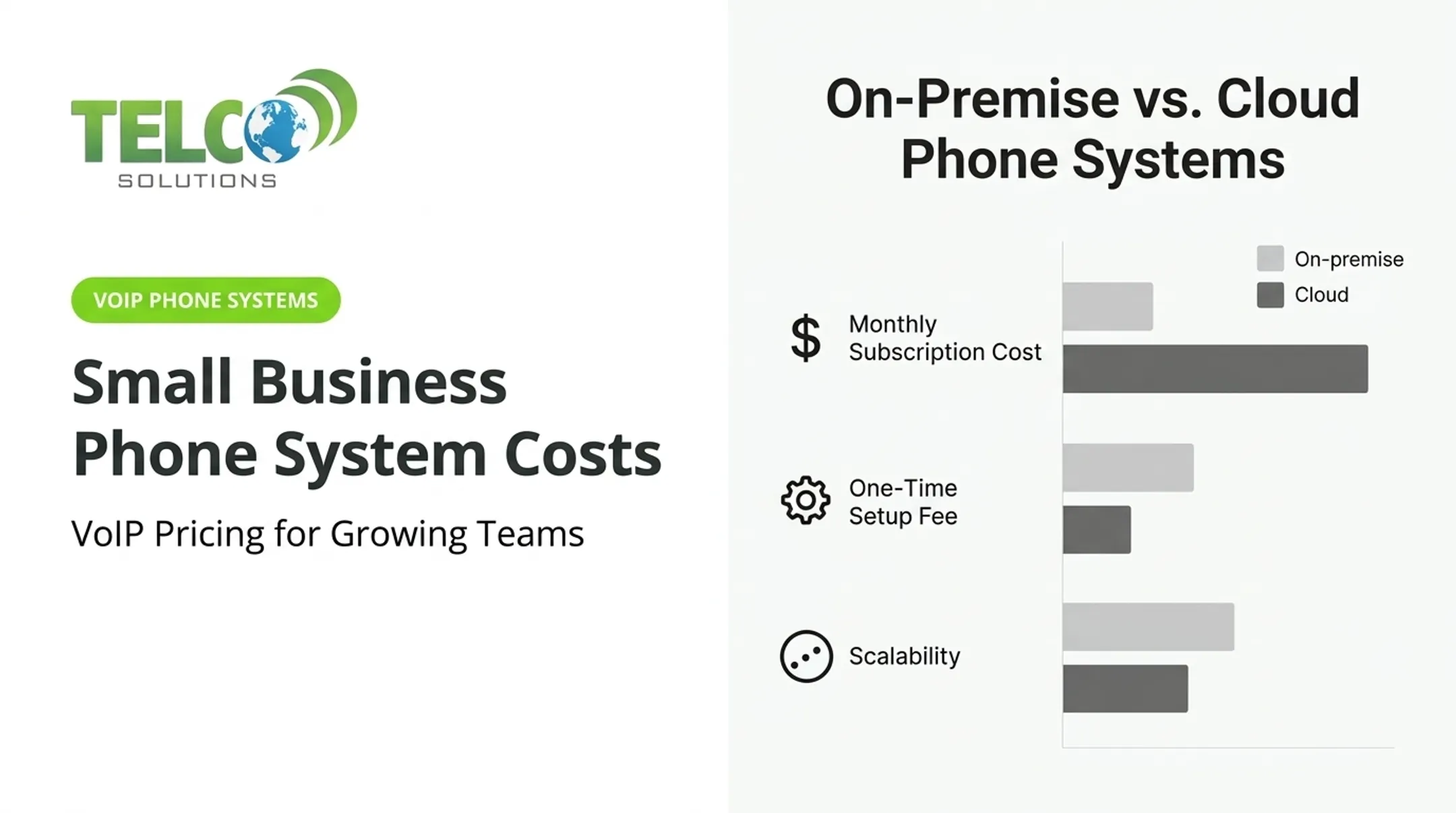
On-premises systems cost more upfront for hardware and install, with lower ongoing fees. Hosted PBX uses a recurring subscription and little upfront spend—which option wins depends on your equipment, IT resources, and growth plans.
What costs should be included in a hosted PBX quote?
A complete quote should break out each of these line items:
- Subscriptions and per-user/extension fees
- Devices, numbers, and porting
- Setup, integrations, and usage charges
- Taxes, support, and network upgrades
- Security/compliance needs and contract terms