
The number of internet phone providers marketing to businesses has exploded, and the cheapest plan advertised rarely turns out to be the cheapest total cost once you factor in porting fees, add-ons, and taxes. Most businesses in major U.S. cities pay $20 to $40 per user per month for business VoIP, but that range hides a lot of variation depending on features, contract terms, and hidden fees.
This guide breaks down what business VoIP actually is, compares leading provider categories, and shows you how to evaluate call quality, integrations, security, and total cost before you sign anything.
Key Takeaways
- Business VoIP runs calls over your internet link across desk phones, computers, smartphones, and messaging tools.
- Pick a provider for your size, call volume, locations, software, and budget, not brand recognition.
- Compare total cost, porting timelines, E911 setup, and contract terms—not just the monthly rate.
- Test shortlisted providers on real devices and call volumes before moving your main business line.
What Is Business VoIP and How Does It Work?
What Business VoIP Means
VoIP stands for Voice over Internet Protocol. It converts your voice into digital data packets and sends them over a broadband connection instead of copper phone lines, according to the FCC. That's the technical core of it.
You'll see several overlapping terms used by providers:
- Hosted VoIP / hosted PBX – the provider runs call routing and voicemail on its own servers
- Cloud phone system – the broader service model where infrastructure lives off-site
- UCaaS – VoIP plus video, messaging, and contact-center tools in one platform
- SIP trunking – the connectivity method linking a phone system to the public network, not a phone system itself
Providers use these terms loosely, so don't assume "UCaaS" and "hosted VoIP" mean the same feature set. Ask exactly what's included.
How Calls Travel Through a VoIP System
A typical setup has three pieces: the provider, your internet connection, and your endpoints (desk phones, softphones, mobile apps).
When you speak, a codec compresses your voice into digital packets. Those packets travel across your office network, out to the provider's data center, then either to another VoIP user or out to the public phone network.
Call quality depends on both sides of that journey:
- Your local network (bandwidth, Wi-Fi strength, router QoS settings)
- The provider's network (routing, redundancy, data center capacity)
Weak Wi-Fi or a bad Ethernet cable causes the same choppy audio as a bad provider network would. Don't blame the vendor before checking your own setup first.
Hosted, On-Premises, and Hybrid Options
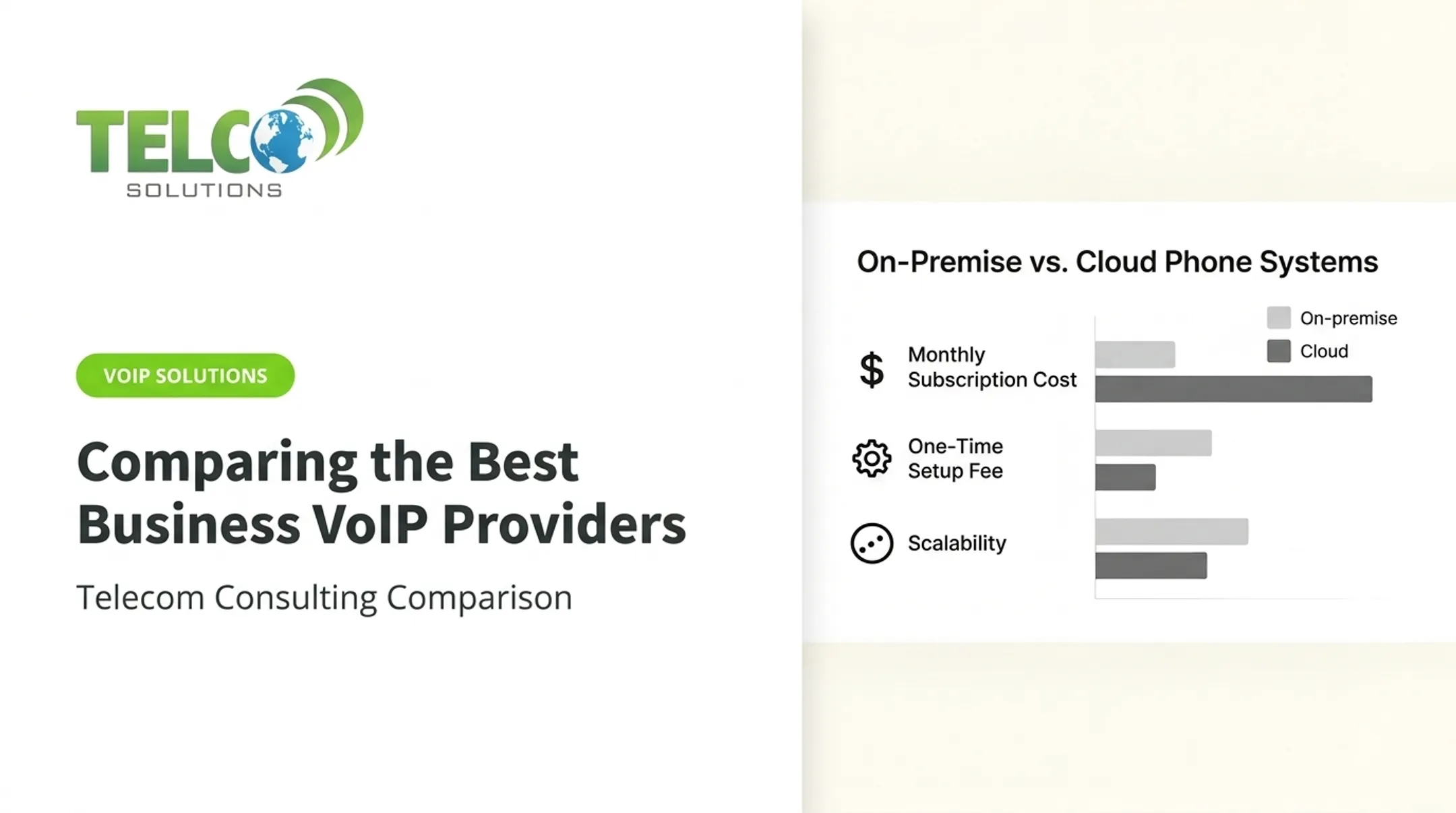
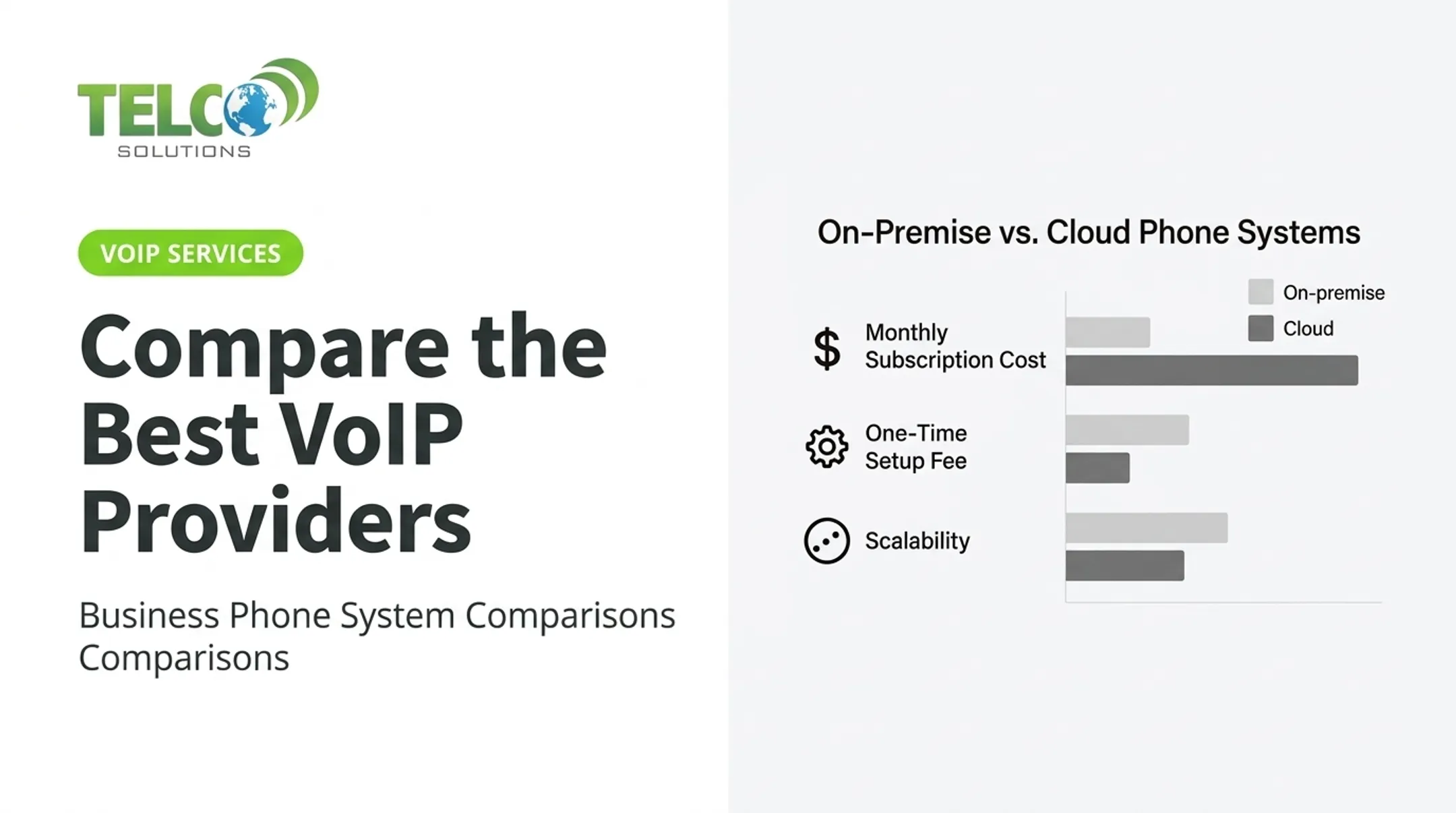
| Model | Ownership | Maintenance | Scalability |
|---|---|---|---|
| Hosted cloud VoIP | Provider owns the platform | Provider handles it | Add users in a few clicks |
| On-premises IP-PBX | Business owns the server | Business or vendor maintains it | Limited by hardware capacity |
| Hybrid (SIP trunking) | Mixed | Split responsibility | Depends on both sides |

Most growing businesses choose hosted cloud VoIP because it removes the upfront hardware cost. Businesses with an existing PBX that isn't ready for full replacement often use SIP trunking as a middle step.
Business Benefits and Trade-Offs
Benefits:
- Add or remove users without new hardware
- Unify voice, video, and messaging in one app
- Work from anywhere with an internet connection
- Cut monthly costs versus dedicated phone lines
Trade-offs to plan around:
- Service depends entirely on your internet connection staying up
- Power outages can take down your phone system unless you've configured backup routing
- E911 requires proper location registration for every device
- Premium features (AI transcription, advanced analytics) often cost extra

Best Internet VoIP Providers for Business
There's no single "best" provider. The right fit depends on your team size, call volume, and existing tools. Always verify current pricing, trial terms, and feature access directly on provider websites before deciding; plans and pricing change often.
Full UCaaS Platforms for Growing Teams
RingCentral bundles voice, video, and messaging with 330+ integrations. It fits businesses wanting modern cloud communications with low implementation complexity, though larger deployments beyond 100 users require custom pricing.
Nextiva combines VoIP, team collaboration, and CRM tools, with published Core, Engage, and Scale tiers ranging $15 to $75 per user per month on annual plans. It's a strong fit for small-to-medium businesses that value responsive customer support.
8x8 targets enterprises needing global reach and advanced contact-center tools. Expect moderate-to-high implementation complexity and custom enterprise pricing. This isn't a same-day setup.
Dialpad leans into AI features like real-time transcription, starting around $15/month for small teams. Phone support is limited to Pro and Enterprise tiers, so check what's included before committing.
Flexible Providers for Existing Collaboration Ecosystems
If your team already lives in Zoom, Zoom Phone adds domestic calling, SMS, and fax without forcing a new interface. Metered plans run $10.50/user/month, while unlimited calling runs $16/user/month, according to Zoom's published pricing.
Vonage offers an API platform for businesses wanting custom communication workflows, CRM call tracking, and mobile access for remote employees. Its promotional annual pricing spans $13.99 to $27.99 per line/month depending on the tier, though new accounts typically require a one-year minimum commitment.
Straightforward Options for Small Offices
Small offices that only need a professional number and basic call handling often choose simpler virtual business lines instead of a full collaboration suite. Those services trade advanced analytics, deep CRM integrations, and contact-center tools for faster setup and lower complexity.
Confirm the gaps before you commit. A basic business line typically omits call queues, detailed reporting, and per-user admin controls.
Providers for Sales Teams and High-Volume Calling
CallHippo targets U.S.-based sales and support teams running high-volume outbound calling. It offers a power-dialer add-on, click-to-dial from inside CRMs, and shared team inboxes for agents.
Things to verify before signing:
- Calling coverage is limited to the U.S. and Canada
- The power dialer is a paid add-on, not included by default
- It's built for high call volume, so low-volume teams may find better value elsewhere
- Deep API customization isn't the focus; it's built for out-of-the-box sales workflows
How to Interpret the Shortlist
Match the category to your actual workflow, not your budget alone:
- Full UCaaS → multi-user teams needing collaboration tools alongside voice
- Ecosystem providers → businesses already invested in Zoom or wanting API flexibility
- Simple business lines → small offices that just need a professional number
- Sales/contact-center platforms → teams managing high call volumes with CRM workflows
Your existing internet capacity, CRM, and number of locations matter more here than brand name. TelcoSolutions helps businesses match those factors to the right VoIP or UCaaS option across a network of 300+ providers.

How to Evaluate and Choose an Internet VoIP Provider
Define Requirements Before Requesting Quotes
Document these before you talk to any sales rep:
- Number of users (include everyone on softphones or mobile apps, not just desk phones)
- Locations and remote workers
- Expected inbound/outbound call volume
- Must-have features: auto-attendant, voicemail-to-email, call recording, mobile app access
- International calling, SMS, fax, and contact-center needs
A 100-employee company might only need 75 phone licenses once you exclude staff who never take calls. Separating "must-have" from "nice-to-have" prevents overpaying for tools nobody uses.
Test Network Readiness and Call Quality
Each simultaneous VoIP call uses roughly 100 Kbps of upload and download bandwidth. A 20-agent team should plan for at least 2 Mbps of dedicated voice bandwidth on top of regular data traffic.
Check these before rollout:
- Wired versus wireless connections at each desk
- QoS settings that prioritize voice packets over file downloads
- Firewall configuration that won't block VoIP traffic
- Internet redundancy in case your primary connection drops
Test calls during busy periods, not just quiet mornings. That's when quality problems actually surface.
Compare Features and Integrations
Look past the marketing page and confirm whether features are native or bolted-on add-ons:
- Auto-attendants and IVR menus
- Call queues and ring groups
- Voicemail transcription and call recording
- CRM, help desk, and calendar integrations
Ask specifically whether a CRM integration is built-in or requires a separate paid connector. That distinction changes your real monthly cost significantly.
Calculate Total Cost of Ownership
Per-user, per-month plans typically run $20–$45/user/month. Metered plans usually charge a $10–$25 base fee plus usage rates. Taxes and regulatory fees can add another 5–20% on top of either model.
Also budget for:
- Number porting fees
- Hardware (desk phones, headsets, PoE switches)
- Onboarding and training time
- Contract auto-renewal terms and cancellation penalties
Verify Reliability, Security, and Emergency Calling
Ask providers directly about:
- Encryption standards (TLS/SRTP) and multi-factor authentication
- Uptime SLAs documented in the contract (not marketing claims)
- E911 registration process for every device, including remote workers' home addresses
- Compliance needs specific to your industry (HIPAA for healthcare, for example)

Use a Pilot and Documented Scoring Process
Before switching everyone over:
- Test with a small group of real users first
- Score each shortlisted provider on cost, call quality, and support responsiveness
- Request case studies or references from similar-sized businesses
- Document who's responsible for porting, training, and post-launch support
Implementation, Security, and Reliability Checklist
Prepare the Network and Backup Connections
Confirm your phones, firewall rules, and bandwidth are ready before install day. A 25–50 Mbps backup connection is typically enough for most small-to-medium businesses to keep phones running if the primary line drops.
Enable TLS/SRTP encryption, restrict SIP/RTP ports to what your provider requires, and turn on fraud alerts for unusual outbound spikes.
Plan for outages with:
- Automatic call forwarding to mobile numbers
- A secondary office location as backup routing
- Battery backup for phones and network equipment
Protect Numbers and Maintain Continuity
Build a porting plan that includes exact account information and a realistic timeline. Never cancel your old service until the port is confirmed complete. A Letter of Authorization is typically required to port toll-free numbers, and businesses own their toll-free numbers under FCC rules, not the provider.
Verify E911 addresses for every device, including remote employees' home offices. Anyone dialing 911 from a VoIP line should state their exact location and floor at the start of the call, since automatic location data isn't always perfectly precise for remote setups.
Manage Rollout and Ongoing Support
A phased rollout beats a single cutover date:
- Assign a project owner and set the timeline
- Test network capacity and configure firewalls/switches first
- Train administrators, then high-priority users
- Use temporary numbers during the port, then switch over
- Review call quality and missed-call patterns after launch

For businesses that want help comparing carriers rather than researching all 300+ options solo, TelcoSolutions works as a nationwide telecom consultancy. It compares VoIP, PBX, and SIP trunking options across its provider network, then handles implementation, porting coordination, and billing support.
Bottom Line
There's no universal winner among internet VoIP providers for business. Match the platform type to how your team actually works:
- Full UCaaS platforms for growing teams that need collaboration tools alongside voice
- Streamlined business-line services for small offices that want a professional number without complexity
- Ecosystem-based providers if you're already committed to tools like Zoom
- Contact-center platforms for high-volume sales and service teams
Before you switch, work through this checklist:
- Build a requirements list
- Calculate the full cost—not just the advertised rate
- Test network performance under real conditions
- Confirm E911 and security processes
A tailored quote based on your actual setup beats guessing from a pricing page every time. TelcoSolutions sources voice and connectivity across 300+ providers so small and midsize businesses get a fit built around their sites, call volume, and budget—not a one-size plan.
Frequently Asked Questions
What is the best internet telephone service?
The best service depends on your business size, call volume, required features, and budget. Compare providers against a documented requirements list rather than relying on rankings alone.
Do I need a landline for a VoIP phone?
No. VoIP doesn't require a traditional landline, but it does need a reliable internet connection and a compatible endpoint like a desk phone, computer, or mobile device.
What is VoIP in telecom?
VoIP is the transmission of voice calls over Internet Protocol networks instead of traditional circuit-switched phone lines. It's technically a subset of the broader category known as IP telephony, according to Cisco.
How much does business VoIP cost?
Pricing varies by user count, calling usage, features, hardware, and contract terms. Compare total cost of ownership rather than the advertised starting price, since add-ons and taxes can add 5-20% or more.
Can I keep my existing business phone number when switching to VoIP?
Usually, yes, if the number is eligible and stays in the same geographic area. Confirm the porting timeline with your new provider and keep your old service active until testing is complete.